AWO Letter - September 17, 2026
Jones Act Waiver Requests Accelerate under Case-by-Case Process; Industry Response to VARs Critical. More than 90 requests for Jones Act waivers have been submitted since the current case-by-case waiver process began August 17. Industry response to the Maritime Administration's Vessel Availability Requests (VARs) is critically important as waiver requests increasingly cover established Jones Act trade lanes, including intra-Gulf cargo movements between and within Texas, Louisiana, and Florida. If you operate tank barges, your engagement is needed now more than ever:
- Establish a clear gameplan within your company for who is receiving and responding to VARs.
- Sign up to receive VARs from MARAD by contacting Patrick Parsons.
- Review each VAR you receive and respond within 24 hours. Even if VARs are for similar cargo and voyages, please respond fully to each request.
- Be accurate in your response while providing as much additional detail and context as possible to help MARAD understand commercial realities. For example: If a VAR seeks a vessel to move 100,000 barrels of a petroleum product from Texas to Louisiana, you should respond to MARAD with any information you can provide, including:
-
- "My company has vessel availability to make that move using X number of tank barges that have XX-barrel capacities."
- "My company has availability to make that move, but it would need to occur X days before/after the proposed timeline."
- "My company doesn't have any vessel availability to make that move, but I know that tank barges with XX capacity routinely move that product between those two locations."
- "My company doesn't have any vessel availability to make that move on this short notice because typically charterers in the commercial market book vessels XX days/weeks before a move."
Under the case-by-case waiver process, MarAd advises the Department of War on the availability of Jones Act-qualified vessels to make the requested moves; DoW has sole authority to grant or deny waiver requests.
AWO will be convening a member call on Thursday, September 24, 11:00am Eastern to provide the latest information and further discuss how members can help. To sign up to join the call, register on your Member Dashboard, here.
House Passes CRA Resolutions on Commercial Harbor Craft, At-Berth Regulations. The House of Representatives on September 16 voted 214-208 on a Congressional Review Act (CRA) resolution, sponsored by Rep. James Gallagher (R-CA), disapproving California's Commercial Harbor Craft (CHC) regulation. This followed a September 15 vote on the At-Berth CRA, sponsored by Rep. Vince Fong (R-CA), which was approved 216-211. The votes now send the measures to the Senate. Sources close to Majority Leader John Thune (R-SD) tell AWO that action prior to lawmakers leaving town for recess is possible if floor time can be secured; otherwise, the measures would likely be taken up during the post-election lame duck session.
Coast Guard Releases Key Bridge Board of Inquiry Report, Requests Feedback. The Board of Inquiry convened by the Coast Guard following the 2024 allision of the Dali with the Francis Scott Key Bridge has released its report. The Board evaluated the risks that larger commercial vessels and increased maritime traffic may pose to critical port infrastructure, conducted vulnerability assessments for 11 ports, reviewed existing Coast Guard waterways risk-assessment tools, and issued 20 recommendations. At a high level, these recommendations call for updated risk-assessment policy and tools, improved monitoring of Marine Transportation System metrics, workforce development, and collaboration with port partners on risk mitigation.
The Coast Guard has requested comment on the report by February 28, 2027. AWO is reviewing the report and plans to provide feedback to the Coast Guard. Members with perspective or operational experience they would like AWO to consider while developing comments should contact Liam Morcroft. The Coast Guard will use the feedback to evaluate the Board's recommendations and develop the Commandant's Final Action Memorandum, which will describe the Coast Guard actions in response to the BOI.
New NAVITA Credentialing Platform Launches. The Coast Guard's mariner credentialing program transformation reached an important milestone when the first phase of the new Navita digital platform launched on September 14. This includes a new process for completing and submitting applications with the goal of providing a more intuitive, guided application process that can ultimately reduce processing delays from incomplete applications. Information from the National Maritime Center about Navita's launch is now available here and additional information is available on the Coast Guard's informational page and Maritime Commons Blog. Additionally, the Coast Guard has created a training guide for mariners and authorized third parties available here.
AWO's Mariner Credentialing Working Group recently met with the Coast Guard to learn more about the system and provided feedback on the operational needs for maritime employers to continue supporting mariners through the credentialing process. AWO is working closely with the Coast Guard to understand how employers can continue to act as authorized third parties for their mariners and provide feedback on how to improve the functionality of the system for mariners and their employers. If you have feedback or questions about Navita, please contact Patrick Parsons.
Coast Guard Establishes Office of Maritime Cybersecurity Policy. AWO welcomes the Coast Guard's official announcement of the establishment of the Office of Maritime Cybersecurity Policy, or CG-MCP, under the Director of Inspections and Compliance. The new office will serve as the Coast Guard's central authority for cybersecurity policy governing ports, vessels, and facilities and as its primary liaison with industry and other government agencies. AWO has already been working closely with this office on implementation of the Coast Guard's cybersecurity regulations and compliance issues affecting members.
CG-MCP's responsibilities include developing domestic policy, collaborating on international standards, coordinating cybersecurity compliance and enforcement strategy, engaging maritime stakeholders and technical experts, and monitoring emerging technologies and cyber risks. AWO looks forward to continuing its collaboration with the office to support clear, practical, and risk-based implementation of cybersecurity regulations across the Marine Transportation System.
Coast Guard Clarifies Cybersecurity Requirements for Inactive Vessels. The Coast Guard recently issued Marine Safety Information Bulletin 04-26 to clarify how Maritime Transportation Security Act requirements apply to vessels during inactive periods. The MSIB explains that vessels retaining a valid Certificate of Inspection but otherwise considered "Inactive," including because of operational seasonality, drydock, or extended dockside maintenance, must continue to comply with applicable cybersecurity requirements in 33 CFR Subchapter H and their approved Vessel Security Plan or Alternative Security Program.
Vessel owners and operators seeking to place a vessel in formal "Laid Up" status must follow the applicable Coast Guard process for withdrawal of the vessel's Certificate of Inspection. Members should review the bulletin when assessing compliance obligations for inactive vessels and contact Liam Morcroft with questions or concerns about potential impacts.
AWO Promotes Partnership with Coast Guard Inspection Chiefs. Caitlyn Stewart, AWO's Vice President - Regulatory Affairs, was invited by the Office of Commercial Vessel Compliance to give a presentation during the office's monthly call with Chiefs, Inspection Division (CIDs) from units across the Coast Guard. The presentation was an opportunity to educate the CIDs about the tugboat, towboat, and barge industry, how AWO members' commitment to safety sets them apart, and how AWO can be a partner and resource to the Coast Guard at the local level. Ms. Stewart also discussed the industry's vessel inspection priorities and use of the Vessel Inspection Feedback Tracker to collaborate more effectively with the Coast Guard to resolve issues and improve service delivery.
AWO Seeks Member Input on Draft SIP Revisions. AWO encourages members to review and provide feedback on the Coast Guard's proposed updates to its Streamlined Inspection Program (SIP) guidance, Navigation and Vessel Inspection Circular 02-99, Change 1. The SIP is a longstanding alternative inspection option under which vessel owners and operators develop and implement a Coast Guard-approved inspection and maintenance program and use company personnel to conduct compliance verification activities. The draft revisions would provide additional regulatory flexibility to SIP enrollees and replace the Joint D8/D9 Tank Barge Streamlined Inspection Program.
In response to an AWO request, the Coast Guard has agreed to extend the deadline for comments to October 23. Members should send Liam Morcroft any questions, comments, concerns, or suggested revisions by September 25.
TSA Holds TWIC Stakeholder Communications Committee Meeting. The Transportation Security Administration recently hosted a TWIC Stakeholder Communications Committee (TSCC) meeting to discuss changes to the TWIC, a recent Government Accountability Office (GAO) audit on the TWIC program, TWIC enforcement operations, and a fee increase. Interested members can register for the next TSCC call in March 2027.
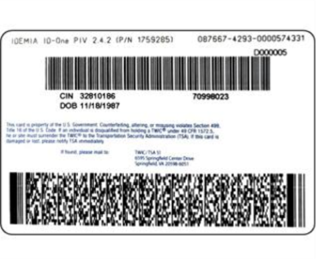
Updates to the TWIC: As of August 2026, new TWICs will be issued with the cardholder's date of birth on the back of the card to help verify that the person holding a TWIC is the authorized holder. (See photo below for example.)
GAO TWIC Audit: GAO found that the basic TWIC framework is operating, but TSA and the Coast Guard are not consistently communicating program changes, using inspection information to identify recurring compliance risks, or electronically checking whether cards have been revoked. GAO also found that the Coast Guard still needs a defined plan for completing its long-delayed rulemaking on which facilities must use TWIC readers.
TWIC Enforcement/Inspection Operations: In 2026, TSA increased its enforcement and inspection operations under 49 CFR 1570.303(a) and (b) at Maritime Transportation Security Act (MTSA)-regulated facilities. During these operations, which are wholly focused on an individual's proper use of a TWIC, the TSA reviews potential alterations, counterfeiting, tampering, etc. to the TWIC. So far, TSA has reviewed almost 14,000 TWICs and revoked close to 700, most due to being on the Canceled Card List. TSA has roughly two dozen of these operations already planned for 2027.
These operations use electronic TWIC readers that are not required by regulation at many MTSA-regulated facilities, so TSA is working with the Coast Guard to correct any potential deficiencies issued following these enforcement operations.
Fee Increase: The FBI is increasing its criminal history records check fee by $3 as of October 1, 2026. TSA will increase the TWIC enrollment fee by $3 following this change.
AWO Comments on Proposed Commercial Space Launch Licensing Streamlining. AWO recently submitted comments to the U.S. Department of Transportation on the Federal Aviation Administration's proposal to waive specified statutory requirements for commercial space launch and reentry actions. AWO supports the continued growth of the U.S. commercial space sector, and recognizes our members are increasingly serving as important partners in that growth. At the same time, our comments emphasized the need to preserve a mechanism for identifying and addressing potential effects on navigation and maritime commerce from this activity.
Record of Decision Signed for IHNC Lock Replacement. Assistant Secretary of the Army for Civil Works Adam Telle has signed the Record of Decision for the Inner Harbor Navigation Canal Lock Replacement Study. AWO has long advocated replacement of the more than 100-year-old lock, an integral piece of navigation infrastructure. The selected plan calls for a new 900-foot-by-110-foot shallow-draft (22') lock, along with related navigation, flood-risk management, bridge, access, and community-mitigation features.
Signing the Record of Decision completes the project's environmental review process under the National Environmental Policy Act and allows the Corps to proceed with engineering and design of the recommended plan. AWO continues to support efforts to move this critical navigation project from planning and design toward construction.
AWO Advocates for Stronger Coast Guard Oversight of Remote Bridges. AWO recently submitted two comment letters (San Bernard River/Old Brazos River) on Coast Guard proposals to authorize remote operation of two Union Pacific Railroad drawbridges in Texas. Following our earlier advocacy, the proposals require the bridges to be maintained in the open-to-navigation position if an operational or remote-system failure occurs. These changes meaningfully address one of AWO's principal safety concerns by prioritizing the safety and right of way of vessel traffic when remote systems are unavailable.
AWO Launches Tribal Fishing Interaction Incident Log. To better track tribal fishing incidents on the Duwamish River, AWO has launched a Tribal Fishing Interaction Incident Log that can be found here. Captains are asked to complete this form after experiencing delays, entanglements, or obstructions related to tribal fishing activity. Additionally, photos or internal company documentation of these incidents can be emailed to nets@americanwaterways.com. All information shared with AWO will be shared with USCG Sector Puget Sound to impress upon the Sector the need for Coast Guard assistance in keeping the Duwamish River open for navigation. Thank you to those who are already sharing information to help AWO resolve this impediment to safe navigation.
CARB Releases New Resources for 2026 GHG Reporting. The California Air Resources Board (CARB) has released new resources to help companies prepare for the first reporting deadline under California's Corporate Greenhouse Gas Reporting Program (SB 253). Reporting entities must submit Scope 1 and Scope 2 greenhouse gas emissions information by November 10, 2026.
The resources include a voluntary 2026 Report Intake Platform, a reporting guidance document, and a video tutorial. While use of the platform is optional, companies may use it to submit contact information, billing details, and emissions reports. Reports may also be submitted directly to CARB via email.
CARB's guidance provides flexibility for the first reporting year, allowing companies to use existing emissions data and alternative reporting formats. Entities that were not collecting emissions data when CARB issued its 2024 enforcement notice may submit a statement of non-reporting.
For more information, please contact Lillie Wightman.
Inaugural Chicago Coast Guard Foundation Dinner Announced for October 16. AWO is pleased to support the Chicago Harbor Safety Committee's invitation to Chicago Maritime Salutes the Coast Guard on Friday, October 16, aboard the Spirit of Chicago at Navy Pier.
The event benefits the Coast Guard Foundation's emergency assistance, scholarships, wellness programs, and family support services with an evening waterfront cruise, dinner, a silent auction, and raffles.
Tickets start at $100. Register or sponsor today and join AWO in giving back to our Coast Guard families. They answer the call for us -- let's answer this one for them!
Summary of NTZ - September 2026. In the latest edition of AWO's Navigating to Zero Safety and Sustainability Newsletter, we examined lessons from the fatal fall overboard aboard the Lauren Rae, including the pulled-under hazard, and highlighted recreational boating safety resources following a fatal boat and barge collision. We shared a High-Value Near Miss involving unsafe gangway access and equipment handling, summarized Coast Guard and NTSB investigation reports, and presented the latest safety alerts. We also reviewed low-water concerns and Waterways Action Plans, covered AWO's work with OCIMF, and shared practical guidance on pre-job safety meetings and mariner health. In addition, we examined global shipping safety trends and resources for managing lithium-ion battery and cybersecurity risks, interviewed Trey Carnegie of Florida Marine Transporters about preventing complacency and strengthening crew communication, and highlighted NTSB's new marine safety dashboard and upcoming industry events.
See these stories and more in the September NTZ and don't forget to send in your SSRP data, High Value Near Misses, and HERO Award nominations to promote continuous improvement. Email Liam Morcroft to set up delivery, or explore past editions of the AWO NTZ on the AWO mobile app.
AWO Fall Convention Is Less than a Month Away! Don't forget to register for the AWO Fall Convention, October 13-14 in West Palm Beach. Download the AWO mobile app before you arrive for the full agenda, event details, and updates. We look forward to seeing you there!
AWO PAC and Inside Elections. AWO PAC has partnered with Inside Elections for another special edition, featuring a big-picture update on the fight for Congress with two months to go before Election Day, as well as a deep dive on the fight for Senate, individual updates and polling in dozens of districts and states, and rating changes in more than 10 races.
AWO PAC is the connected political action committee for The American Waterways Operators and serves as the trade association's separate segregated fund. As a trade association, AWO is prohibited from using general treasury funds or membership dues to make federal contributions. AWO is one of the most effective advocacy associations in Washington, DC, and relies on voluntary personal contributions to fund AWO PAC.
AWO PAC supports federal candidates who are champions of the U.S. tugboat, towboat, and barge industry and who are leaders on issues important to our industry. AWO PAC is dedicated to protecting AWO members' investments in the safest, most environmentally responsible and most economical mode of freight transportation and safeguarding the integrity of the Jones Act to protect the bottom lines of our members.
AWO PAC may solicit contributions from individuals of a member company once the member representative gives AWO written prior approval.