AWO Letter - August 6, 2026
Jones Act Waiver Fight Update. With the Jones Act waiver expiration date quickly approaching and an announcement on a possible extension expected at any time, AWO is continuing its maximum pressure campaign urging the White House not to extend the waiver. Briefings with lawmakers and key Trump Administration officials have been taking place on a daily basis to convey economic data, as well as to highlight the security risk of Chinese-controlled and Russian-crewed vessels now operating in domestic routes. AWO has also been working closely with the American Maritime Partnership to intensify public affairs campaign efforts targeting Washington, DC policymakers.
Our collective efforts have made a difference: while a broad, blanket waiver extension appeared imminent three weeks ago, our intense, united pushback has changed the White House calculus. AWO understands that the White House is considering an extension that would run for 90 days (timed to extend through the midterm elections and then expire) and be issued under 56 USC 501(a), with waivers assessed on a case-by-case basis with an opportunity for U.S.-flag vessels to demonstrate availability first. We also expect a narrowing of the commodities that can be carried under the waiver and potential geographic restrictions on waiver use.
While this is progress, it is not sufficient. The facts do not support the talking point that the Jones Act waiver has delivered relief for American consumers. Instead, the waiver has shifted routine domestic commerce to foreign operators, including entities linked to China and Russia, while undermining the U.S. maritime industrial base that President Trump himself has acknowledged is vital to our national security.
Please join AWO in taking action today to urge the White House not to extend the waiver. You can do this by urging your Senators and Representative to contact the White House ASAP today, and by sending the same message to the Trump Administration or key state officials with whom you have a relationship.
Click Here to Contact Your Members of Congress
Jennifer observed: "If we were worried about a shortage [of fuel products], we wouldn't be exporting a billion-and-a-half barrels of oil since this conflict began, we'd be keeping some of that here for domestic needs. So it's just not benefitting American consumers, it's introducing security risks to the homeland, and it's really undermining the maritime industrial base that the President and his administration have said they want to prioritize."
Listen to the full episode here.
New Studies Document Damage and Security Threats of Current Jones Act Waiver. A new study conducted by PricewaterhouseCoopers estimates that a long-term Jones Act waiver risks up to $26.5 billion in domestic shipbuilding demand over 10 years, 133,700 U.S. jobs generating $12.2 billion in annual labor income, $2.6 billion in maritime capital investment annually, and $1.8 billion in annual tax revenue. Additionally, the Coalition for a Prosperous America issued a new analysis concluding that the current Jones Act waiver "has not been shown to meet its legal test, opened America's coastwise trade to Chinese- and Russian-linked ships, and produced no demonstrated national fuel-price relief. It should expire on August 16."
AWO will continue leveraging data like this with the Administration to demonstrate how real-world harms caused by the existing Jones Act waiver far outweigh hoped-for reductions in consumer fuel prices that have not materialized.
AWO Engages Coast Guard to Prepare for Another Possible Government Shutdown. Appropriations for the federal government are set to expire on September 30. If the House and Senate are not able to reconcile their stopgap spending bills to extend the deadline to December 11, the federal government will shut down again on October 1. To minimize the impact of a shutdown on members, AWO is actively working with the Coast Guard and industry partners to address the issues that disrupted maritime commerce during the previous lapse in appropriations for the Department of Homeland Security earlier this year.
AWO is focused specifically on ensuring the continuity of operations of the National Maritime Center. In addition to conversations with NMC leadership and RDML Robert Compher, new Assistant Commandant for Prevention Policy, to discuss contingencies for mariner credentialing services, AWO and industry partners are supporting legislative proposals to exempt employees at the NMC (as well as the National Vessel Documentation Center) from future shutdowns. Please contact Caitlyn Stewart for more information.
House Passes NDAA With Major Maritime Provisions. On July 22, the House of Representatives adopted its fiscal year 2027 National Defense Authorization Act by a vote of 216-212. Championed by House Armed Services Seapower Subcommittee Chair Trent Kelly (R-MS) and House Coast Guard Subcommittee Chair Mike Ezell (R-MS), the House NDAA includes numerous provisions from the SHIPS for America Act and legislative proposals offered by the White House for implementing the Maritime Action Plan, including:
- Creation of the Maritime Security Advisor as a new special advisor to the President and creation of a Maritime Security Board to oversee implementation of the national maritime strategy.
- Establishment of the Maritime Security Trust Fund (however, no funding mechanism was specified).
- Centralizing cargo preference nonavailability determinations and waiver authority in the Maritime Administrator and increasing government cargo preference from 50% to 100%.
- Establishment of a new Shipbuilding Financial Incentives federal grant program.
- Directing a rulemaking committee process to modernize commercial maritime regulations and standards.
- Expanding maritime workforce and education.
The House-passed NDAA now awaits action in the Senate.
AWO Continues Work on Cybersecurity Compliance Tools for Members. AWO continues to make significant progress preparing members for implementation of the Coast Guard's cybersecurity regulations under 33 CFR Part 101, Subpart F. Recent work has focused on two goals: advocating with the Coast Guard for a practical, risk-based approach; and developing compliance tools that reflect the systems, operations, and cybersecurity risk profile of the domestic barge and towing industry.
As previously reported, AWO has completed a baseline cybersecurity assessment and is now focused on turning that work into practical compliance tools. To streamline compliance with training requirements, this week AWO submitted to the Coast Guard a contractor training attestation form template, which the Coast Guard has agreed to review to ensure it meets the agency's documentation expectations. AWO is also preparing to submit a waiver request for barges covered by the AWO Alternative Security Program with minimal or no vessel-based IT or OT systems before turning attention to the development of a towing vessel-focused cybersecurity annex for the AWO ASP.
AWO also continues to engage with the Coast Guard's Office of Maritime Cybersecurity Policy and will host Coast Guard cybersecurity personnel at the Ohio Valley Region Coast Guard Luncheon in Paducah later this month to discuss the regulation, emerging cyber threats, and incident response support. For more information, or to join one of AWO's Cybersecurity Working Groups, please contact Liam Morcroft.
AWO Continues Work on Cybersecurity Compliance Tools for Members. AWO continues to make significant progress preparing members for implementation of the Coast Guard's cybersecurity regulations under 33 CFR Part 101, Subpart F. Recent work has focused on two goals: advocating with the Coast Guard for a practical, risk-based approach; and developing compliance tools that reflect the systems, operations, and cybersecurity risk profile of the domestic barge and towing industry.
As previously reported, AWO has completed a baseline cybersecurity assessment and is now focused on turning that work into practical compliance tools. To streamline compliance with training requirements, this week AWO submitted to the Coast Guard a contractor training attestation form template, which the Coast Guard has agreed to review to ensure it meets the agency's documentation expectations. AWO is also preparing to submit a waiver request for barges covered by the AWO Alternative Security Program with minimal or no vessel-based IT or OT systems before turning attention to the development of a towing vessel-focused cybersecurity annex for the AWO ASP.
AWO also continues to engage with the Coast Guard's Office of Maritime Cybersecurity Policy and will host Coast Guard cybersecurity personnel at the Ohio Valley Region Coast Guard Luncheon in Paducah later this month to discuss the regulation, emerging cyber threats, and incident response support. For more information, or to join one of AWO's Cybersecurity Working Groups, please contact Liam Morcroft.
Coast Guard Releases Retrospective Analysis of 2012 Ballast Water Management Standards. The U.S. Coast Guard recently released a retrospective analysis of its 2012 Ballast Water Discharge Standards, using new data sources and updated methods to assess the rule's costs and benefits.
The report finds that industry has borne many of the up-front costs associated with ballast water management system (BWMS) implementation, while net benefits will not actualize until approximately 2045. Additionally, widespread adoption of BWMS technology has dramatically reduced aquatic invasive species invasion rates.
AWO is preparing comments urging the Coast Guard to consider the report's findings as it develops regulations to implement the Vessel Incidental Discharge Act. For more information, please contact Lillie Wightman.
EPA Submits Commercial Harbor Craft Rule Waiver to Congress. On July 22, the Environmental Protection Agency submitted to Congress both the Commercial Harbor Craft Rule amendments and the Ocean-Going Vessels At Berth ("CARB at Berth Rule") for potential action under the Congressional Review Act. This action follows AWO advocacy efforts with EPA and House and Senate Committee staff as a potential source of relief for members. Under the CRA, Congress has 60 legislative days to introduce a joint resolution of disapproval, which requires a simple majority in both the House and Senate to pass, as the filibuster does not apply and debate in the Senate is capped at 10 hours. If a resolution were to pass both chambers, it would require the President's signature to become law.
AWO will continue to advocate with the California Air Resources Board for solutions members need from CARB while at the same time working to support efforts to strike the 2022 amendments to the Commercial Harbor Craft rule. Please contact Kyle Burleson with any questions or feedback.
COMMENT OPPORTUNITY: CARB Releases 15-Day Notice on Climate Disclosure Program. The California Air Resources Board (CARB) recently released a 15-day notice of modifications to its Corporate GHG Emissions Reporting and Climate-Related Financial Disclosure program regulations. Among the proposed changes is a delay of the first-year Scope 1 and Scope 2 GHG emissions reporting deadline from August 10, 2026, to November 10, 2026, along with several definition clarifications.
AWO is reviewing the proposed changes and formulating comments to submit by the August 11 deadline. Members who meet the programs' revenue thresholds and have concerns they would like reflected in our comments should contact Lillie Wightman as soon as possible.
AWO Members Meet with Sector Puget Sound in Seattle. AWO members from across the Pacific Region gathered in Seattle on July 30 for a Member Roundtable Discussion with Sector Puget Sound leadership. The discussion centered on Jones Act advocacy, strengthening AWO's partnership with the Coast Guard, and celebrating recent wins including the ATB crewing implementation guidance. AWO staff also highlighted the relaunch of the AWO Pacific Region Quality Partnership, which will enhance communication and problem-solving across units. Coast Guard leaders CDR Sarah Rodino and CAPT Michael Hunt joined the conversation and encouraged members to reach out directly as issues arise. For more information, contact Peter Schrappen.
AWO Comments on Interstate Bridge Replacement Navigation Impacts. AWO recently submitted comments to the U.S. Coast Guard's Northwest District regarding anticipated navigation impacts during construction of the new I-5 Bridge Replacement over the Columbia River between Portland, Oregon, and Vancouver, Washington. The project as proposed would involve several years of construction activity, including a period when vessel traffic would be consolidated into a single navigation channel.
Our comments outlined that while we continue to support replacing the aging bridge, planners need to address impacts on commercial navigation and regional commerce during construction. Specifically, we raised concerns about the reliability of the bridge's moveable span, the safe placement of construction equipment near navigation channels, and the need for adequate support for commercial vessels operating through the restricted area.
MARAD Establishes Arctic Shipping Advisory Committee and Seeks Members. The Maritime Administration is currently soliciting nominations to fill nine seats on its newly-created Arctic Shipping Federal Advisory Committee (ASFAC). Mandated in the 2021 National Defense Authorization Act, ASFAC will develop policy recommendations to improve the safety and reliability of Arctic maritime transportation, including options for establishing a U.S. entity that can perform seaway development functions consisting of: constructing and operating maritime infrastructure; providing services that are not widely commercially available; and establishing charges or fees for services. Membership details are available here, and applications must be submitted by September 22, 2026.
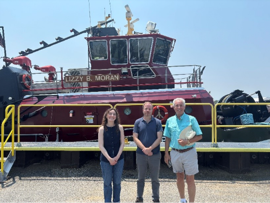
AWO Hosts Georgia Lawmaker for Savannah Tugboat Tour. AWO and Moran Towing recently hosted Georgia State Representative Ron Stephens, Chairman of the House Economic Development and Tourism Committee, for a tour aboard the Lizzy B. Moran in Savannah. The visit provided the opportunity to discuss issues affecting the maritime industry, strengthen relationships with policymakers, and increase awareness of the vital role the tugboat, towboat, and barge industry plays in Georgia's economy.
Rep. Stephens and Rep. Jesse Petrea have agreed to sponsor a pro-maritime resolution that AWO plans to help advance in Georgia during the next legislative session.
AWO Joins New Inspector Training at TVNCOE. AWO Southern Region Vice President Jill Bessetti recently participated in training for new inland towing vessel inspectors at the U.S. Coast Guard's Towing Vessel National Center of Expertise in Paducah, Kentucky. Fifteen inspectors from across the country attended the session. During the training, Jill provided an overview of AWO membership requirements, the Alternative Security Program, AWO working groups, and the Safety Statistics Reporting Program. Safety and compliance professionals from Ingram Barge Company also participated, enhancing the presentation by sharing real-world examples and industry expertise. The training provided a valuable opportunity for collaboration and knowledge sharing between industry representatives and Coast Guard inspectors.
Summary of July 2026 NTZ. In the latest edition of AWO's Navigating to Zero Safety and Sustainability Newsletter, we reviewed the Summer Safety Meeting in Chicago, shared Coast Guard Investigation Reports, summarized recent NTSB Casualty Reports, and presented the latest USCG and BSEE Safety alerts. We also shared AWO's outlook on emerging risks, with updates about recent work to prevent lithium ion battery thermal runaway and a plan to bring small modular nuclear reactors (SMR) to commercial shipping. In addition, we covered AWO's contribution to a new Library of Resources published by the National Association of State Boating Law Administrators (NASBLA), interviewed John Shkor of Vane Brothers, and celebrated the winners of the American Waterways HERO Award, who were recognized at the HERO Award Ceremony in July.
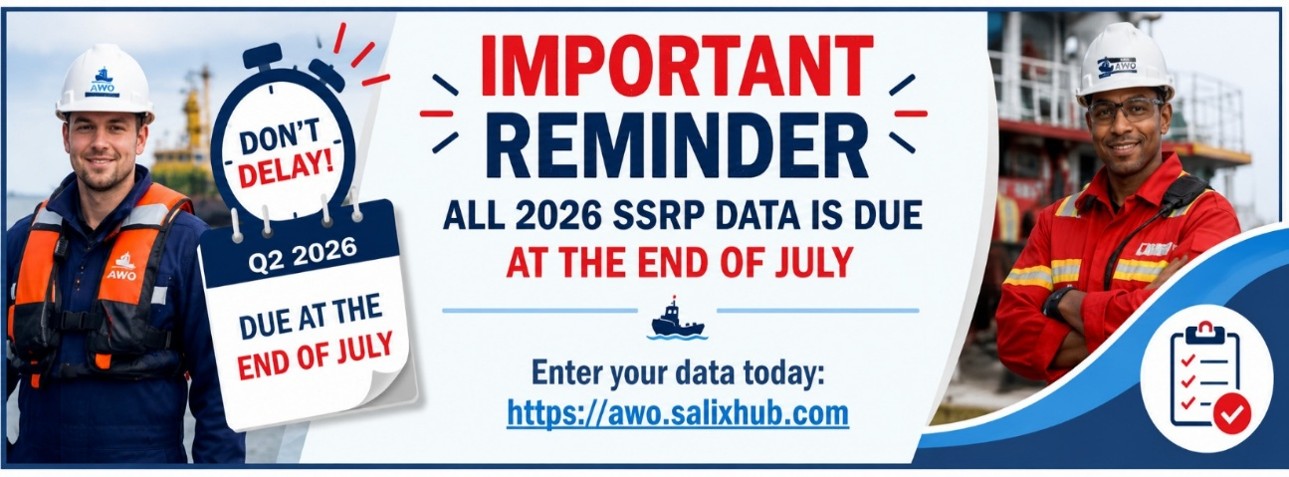
See these stories and more in the July NTZ and don't forget to send in your SSRP data, High Value Near Misses, and HERO Award nominations to promote continuous improvement. Email Liam Morcroft to set up delivery or explore past editions of the NTZ newsletter on your iPhone or Android mobile app.
AWO PAC and Inside Elections. AWO PAC has partnered with Inside Elections for another special edition, featuring updates on Senate races in Maine and South Carolina; second quarter fundraising charts; dozens of updates in House, Senate, and gubernatorial races around the country; and a review of recent redistricting efforts.
AWO PAC is the connected political action committee for The American Waterways Operators and serves as the trade association's separate segregated fund. As a trade association, AWO is prohibited from using general treasury funds or membership dues to make federal contributions. AWO is one of the most effective advocacy associations in Washington, DC, and relies on voluntary personal contributions to fund AWO PAC.
AWO PAC supports federal candidates who are champions of the U.S. tugboat, towboat and barge industry and who are leaders on issues important to our industry. AWO PAC is dedicated to protecting AWO members' investments in the safest, most environmentally responsible and most economical mode of freight transportation and safeguarding the integrity of the Jones Act to protect the bottom lines of our members.
AWO PAC may solicit contributions from individuals of a member company once the member representative gives AWO written prior approval.