AWO Letter - October 23, 2026
Congressional Leaders Seek Answers on Jones Act Waiver, COSCO Shipping Activity. Key Members of Congress recently sent two letters to Secretary of Homeland Security Markwayne Mullin highlighting the urgent need for Jones Act waiver oversight and the national security implications of Chinese shipping activity near U.S. waterways, respectively.
In an October 16 letter to Secretary Mullin, Rep. Salud Carbajal (D-CA), Ranking Member of the House Subcommittee on Coast Guard and Maritime Transportation, requested the agency detail the administration and oversight of Jones Act waivers in light of recent reporting that foreign-flagged vessels have transported more than $40 million in petroleum products without required disclosures. His letter requests detailed information in four areas: federal tax compliance, immigration status of foreign crewmembers, enforcement of other maritime and labor regulations, and documented coordination among federal agencies. The letter also highlights the Administration's IRS guidance, provided in response to a request from Sen. Maria Cantwell (D-WA), that confirms that income earned by foreign corporations from operating vessels under the waiver constitutes domestic-source income and is not eligible for Section 883 exclusion. Rep. Carbajal requested DHS address his questions by October 31. Rep. Carbajal's full letter is available here.
In a separate letter to Secretary Mullin, Reps. John Moolenaar (R-MI), Chairman, Select Committee on the Chinese Communist Party; Rick Crawford (R-AR), Chairman, House Intelligence Committee; and Carlos Gimenez (R-FL), Chairman, House Subcommittee on Transportation and Maritime Security, highlighted public reporting that Chinese government-owned COSCO Shipping Corporation vessels have been conducting espionage operations near U.S. coastlines yet COSCO vessels remain enrolled in a U.S. Coast Guard program that provides special privileges for participating vessels arriving in U.S. ports. Though the letter itself does not mention the Jones Act, it serves to underscore the severe national security risks of opening domestic shipping to foreign-flagged vessels, especially China-owned vessels, which have already engaged in U.S. domestic commerce under the Jones Act waiver.
Jones Act Public Affairs Campaign Continues with AMP Ads Relaunch, VOICES Mobilization, Gas Prices Podcast. AWO continues to work alongside the American Maritime Partnership in using public affairs channels to call for ending the Jones Act waiver. AMP has relaunched two key ads that are currently running on Fox News and CNBC in the DC metro area. The first ad, Talking Point, underscores that despite waiver proponents' promises that waiving the Jones Act would help lower gas prices, the waiver has not only failed to do so but has actively harmed American maritime jobs and investment; while the second ad, Republican Leaders Say End the Waiver, highlights opposition to the waiver among the President's allies in Congress.
With the midterm elections approaching fast, AWO encourages our members to amplify this messaging by using AMP's American Maritime VOICES platform to write Congress and urge your elected representatives to oppose any effort to extend the waiver. You can make your voice heard here.
AWO President & CEO Jennifer Carpenter also recently interviewed David St. Amand, President of Navigistics Consulting, for an episode of the American Maritime Podcast. This past summer, Navigistics released a critical study examining the effects of the waiver on the U.S. economy and energy security that has been vital to AMP and AWO communications efforts.
During the interview, David noted Navigistics's findings that Jones Act transportation has miniscule effect on the price of gasoline at the pump -- less than a tenth-of-a-cent per gallon; that gasoline prices are set by other factors including global energy markets, refining costs, taxes, and others; and that waiver movements have consisted almost entirely of foreign vessels moving cargo in routine commercial service despite the national defense justification given by the Trump administration for the waiver. The full episode is available here.
REMINDER: Comments on Proposed SIP Changes Due October 29. The Coast Guard recently published proposed changes to its Streamlined Inspection Program (SIP). The proposal would affect both SIP and D8/D9 Tank Barge SIP (TBSIP) users, replacing the existing TBSIP with the proposed SIP framework outlined in the draft Navigation and Vessel Inspection Circular (NVIC) 02-99, Change 1.
AWO is submitting comments based on member feedback and encourages members to submit their own comments as well. Members may also share questions, concerns, operational impacts or suggested revisions with Liam Morcroft or Caitlyn Stewart.
Coast Guard Releases Guidance on Cybersecurity Plans. Earlier this week, the Coast Guard Office of Maritime Cybersecurity Policy (CG-MCP) released Navigation and Vessel Inspection Circular (NVIC) 02-26. NVIC 02-26 provides guidance on the Coast Guard's cybersecurity regulations and focuses primarily on the development of Cybersecurity Plans under 33 CFR Part 101 Subpart F. This guidance follows CG-5PC Policy Letter 01-26, which provided guidance on the Cybersecurity Assessment process, the first step in developing a Cybersecurity Plan. AWO is reviewing the NVIC and encourages members to reach out to Liam Morcroft with any questions or concerns about the new guidance.
FDA Finalizes Oral Fluid Testing Deregulatory Action. The Food and Drug Administration (FDA) recently issued a final order removing regulatory burdens for laboratories to be certified to conduct oral fluid testing. Under federal workplace drug testing regulations, implemented through the U.S. Coast Guard, oral fluid testing cannot be used by maritime employers until at least two laboratories are certified. This move, which AWO supported throughout the regulatory process, follows a joint letter from the Passenger Vessel Association, AWO, Chamber of Shipping of America, and Offshore Marine Services Association in July 2025 to Secretary of Health and Human Services Robert F. Kennedy, Jr. urging the Administration to reduce regulatory obstacles to laboratory certification. For questions about the FDA's deregulatory action or oral fluids testing, please contact Patrick Parsons.
AWO Submits Amicus Brief Supporting Federal Preemption. As authorized by AWO's Board of Directors last year, last week AWO submitted an amicus brief in the Court of Appeal of the State of California's Westoil Marine Services v. Klarin. The case, which involves AWO member Centerline Logistics and directly impacts all operators in California, will determine whether a state rule requiring mariners to be completely relieved of duty during short, incremental meal and rest breaks throughout their work period is preempted by federal law. AWO's brief details the full reach of federal law and regulation over vessel manning, watchstanding, work and rest, credentialing, and a mariner's duty to respond to the vessel Master, to establish federal field preemption in regulating the work and rest of mariners while onboard a vessel. If you have questions or would like a copy of AWO's brief, contact Patrick Parsons.
AWO Joins Maritime Industry in Opposing VTS Privatization. AWO recently joined six other national maritime organizations in a letter to congressional leaders expressing the industry's unequivocal opposition to any effort to privatize, in whole or in part, U.S. Coast Guard Vessel Traffic Service (VTS) centers. The coalition included the American Association of Port Authorities, American Pilots' Association, AWO, Chamber of Shipping of America, International Organization of Masters, Mates and Pilots, Passenger Vessel Association, and Waterways Council, Inc. The letter notes that the case for federally staffed and managed VTS centers has been examined and reaffirmed by independent bodies and Congress at least three times since passage of the Ports and Waterways Safety Act of 1972.
The letter identifies five principal concerns with privatization: degradation of navigational safety and increased incident risk; severing the direct chain of command with the Captain of the Port; maritime and border security implications; cybersecurity vulnerabilities and commercial data conflicts; and erosion of Coast Guard maritime domain awareness and expertise. Together, the organizations emphasized that VTS centers are a core public safety function and should remain under direct Coast Guard management. Read the full letter here.
The letter was proactive and was not prompted by a specific Coast Guard action to privatize VTS. Coast Guard officials have repeatedly indicated that the agency is not seeking to privatize VTS or divest its authorities and jurisdiction. However, maritime stakeholders have continued to hear discussion of potential privatization from within government and the private sector, prompting the coalition to make the industry's concerns and opposition clear to Congress.
AWO Convenes Working Group to Solicit Navita Feedback. Following the launch of the Coast Guard's new Navita mariner credentialing platform in September, AWO convened its Mariner Credentialing Working Group to solicit feedback from members. Members identified several priority areas for improvement including functionalities for employers acting as authorized third parties, inaccurate fees, and other communication and usability issues that are creating confusion and challenges for mariners. AWO is actively engaged with the Coast Guard to secure improvements on these issues. If you'd like to join the Mariner Credentialing Working Group, contact Patrick Parsons. Additionally, STAR Center is hosting a listening session on November 19 in Dania Beach, FL, to provide feedback to the Coast Guard on Navita and its mariner credentialing program transformation initiative. Details on participating can be found here.
AWO Comments on Maritime Impacts of Commercial Space Operations. AWO recently submitted two comment letters to the Federal Aviation Administration related to commercial space launch and reentry operations that could affect vessel operations. AWO reiterated its support for the continued growth of the commercial space industry, in which AWO members play an important role, while emphasizing that these activities must be planned and permitted in a way that protects navigational safety and minimizes impacts to vessel operations and maritime commerce. AWO urged FAA to fully consider existing vessel traffic, potential conflicts with shipping routes and fairways, and the operational impacts of vessel restrictions, delays, or rerouting as it evaluates future launch and reentry activities.
MARAD Proposes Changes to Capital Construction Fund. The Maritime Administration has issued a Notice of Proposed Rulemaking to revise the application process and fund administration for the Capital Construction Fund (CCF) Program. The CCF is a tax-deferral program for vessel construction funds. The changes are intended to ease burdens and expand access to the program for maritime operators. The NPRM would implement statutory changes extending the program to all U.S.-built vessels in domestic and foreign operations, remove geographic limits, and clarify reconstruction timelines, vessel acquisition rules, and account termination processes. The NPRM comment period is open through November 23.
DERA Grant Applications Open. The U.S. Environmental Protection Agency has issued a Notice of Funding Opportunity for the Diesel Emission Reduction Act (DERA) national grant program for 2026. Approximately $180 million is available for this year's program. Marine engines and cargo handling equipment are eligible for DERA funds, but private companies cannot apply directly for the national program. Instead, private entities can apply for state-level DERA grants or partner with public entities such as port authorities or municipalities. Thirty percent of total annual DERA funds are allocated to state environmental agencies, so interested companies should be on the lookout for state-level program announcements. The application deadline for the national program is January 22, 2027.
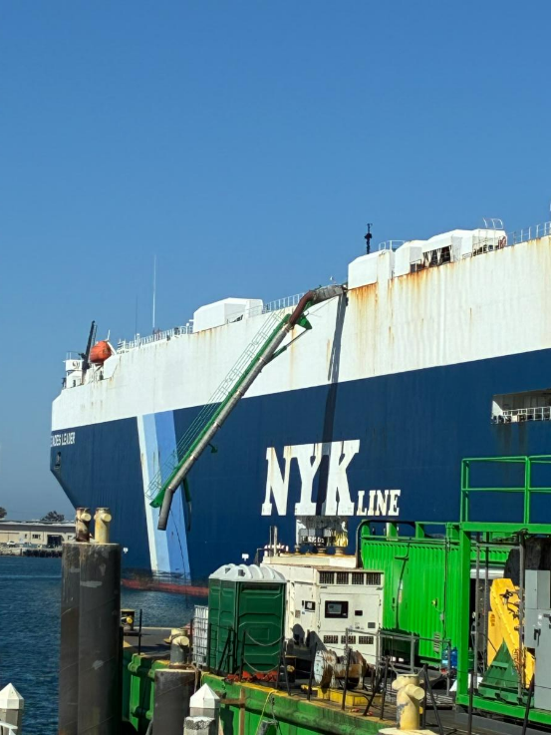
AWO Engages on Emissions Capture Barge Safety. AWO is coordinating with the Pacific Merchant Shipping Association (PMSA) and other industry partners to address serious safety concerns following the October 5 failure and collapse of a Capture and Control Emission Strategy (CAES) barge at California's Port of Hueneme that caused severe damage to the ship being serviced. No injuries were reported. Video of the incident is available here and photos are below.
PMSA is seeking interim safety exceptions from the California Air Resources Board to allow time for an independent investigation and completion of corrective actions. Industry partners are also seeking a formal Coast Guard investigation and clear safety standards for these operations.
Members using CARB-approved CAES barges are encouraged to consult their safety teams and counsel about continued use in light of this recent serious incident.
Please contact Kyle Burleson or Mike Breslin for more information or to report a dangerous condition.
Towboat and Harbor Carriers Discuss Plans for State Outreach in NY/NJ. Last month, the Towboat and Harbor Carriers Association for the Port of New York and New Jersey met in Staten Island to discuss its advocacy successes over the past year and to brainstorm advocacy strategy for New York and New Jersey in 2027. Executive Director Eric Johansson and Chairman Nathan Hauser, Moran Towing Corporation, briefed members on the association's work to promote the heroism of New York mariners in conjunction with September 11 remembrance events, noted its collaborations with industry partners to advocate for an end to the Trump Administration's harmful Jones Act waiver, and gave government partners from New York and New Jersey the opportunity to promote ongoing port studies in both states aimed at identifying maritime needs.
These discussions were used to kick off a larger conversation among Harbor Carriers members about how to focus state advocacy efforts for the upcoming legislative sessions. The Association agreed that building a maritime caucus in these two important legislatures and further developing allies within state-level agencies to support maritime are among the key priorities. The Harbor Carriers discussion coincides with AWO's efforts to build up its presence in Albany and Trenton, and we look forward to further collaborating with the Harbor Carriers on this important effort.
AWO Members Gather for Fall Convention and Board Meeting. AWO members gathered in West Palm Beach on October 13-14 for the 2026 Fall Convention and Board of Directors Meeting, with the theme Navigating Disruption: Strength. Strategy. Resilience. The Convention provided an outstanding opportunity for members to conduct important association business, learn from industry leaders and experts on emerging challenges and opportunities, and reconnect with colleagues from across our industry.
During the Board meeting, members discussed key issues affecting the organization and the industry including the current Jones Act waiver, proposed changes to the Coast Guard's Streamlined Inspection Program, and AWO's preparations and plans for the 120th Congress; approved AWO's 2027 budget; and learned about the launch of AWO's Governance Committee.
During the next day's education session, panelists and attendees discussed cyber incident response, emerging uses of the nation's waterways, ways companies can proactively strengthen their public image before a crisis hits, and the opportunities and risks associated with the rapidly expanding use of artificial intelligence in the tugboat, towboat and barge industry. Members also participated in sector breakout sessions focused on the sector-specific issues impacting their operations. Stay tuned for information on AWO's 2027 meeting schedule and make plans to join us early in the New Year!
AWO Hosts Midterm Elections Results Webinar. Please plan to join us on Friday, November 6 at 2 p.m. EDT as AWO's Craig Montesano and Joe Manion discuss the results of the 2026 midterm elections and impacts for AWO's Congressional advocacy in the 120th Congress.
AWO PAC and Inside Elections. AWO PAC has partnered with Inside Elections for another special edition, featuring the latest on the fight for Congress, race rating changes in more than two dozen races, and updated polling and analysis in dozens more.
AWO PAC is the connected political action committee for The American Waterways Operators and serves as the trade association's separate segregated fund. As a trade association, AWO is prohibited from using general treasury funds or membership dues to make federal contributions. AWO is one of the most effective advocacy associations in Washington, DC, and relies on voluntary personal contributions to fund AWO PAC.
AWO PAC supports federal candidates who are champions of the U.S. tugboat, towboat, and barge industry and who are leaders on issues important to our industry. AWO PAC is dedicated to protecting AWO members' investments in the safest, most environmentally responsible and most economical mode of freight transportation and safeguarding the integrity of the Jones Act to protect the bottom lines of our members.
AWO PAC may solicit contributions from individuals of a member company once the member representative gives AWO written prior approval.