AWO Letter - August 21, 2026
Trump Administration Issues Modified 90-day Jones Act Waiver Extension. As reported in an August 10 AWO Alert, the Trump Administration last week extended the Jones Act waiver for an additional 90 days, beginning August 17. The extension included two modifications from the preceding waivers:
- A requirement that the Department of War consult with the Maritime Administration on the availability of Jones Act-qualified vessels to conduct an individual voyage prior to determining whether the waiver will apply to that voyage; and,
- A narrowing of the scope of commodities covered by the waiver to: fuel blend stocks, diesel, gasoline, jet fuel, crude oil, fuel oil, gas oil, bunker fuel, liquefied petroleum gas, bitumen, pet coke, chemicals derived from petroleum or natural gas, liquefied natural gas, naphtha, soybean oil and fertilizers.
While AWO appreciates the dialogue with Administration officials that led to these changes, we are deeply disappointed that the waiver has been extended when the public record over the last five months makes clear that the waiver has not been driven by military needs (the statutory standard), has not reduced the price of gasoline for U.S. consumers, and has allowed foreign vessels to take work from Americans.
Our advocacy work is now focused on working with the Administration and Congress to ensure that any request by a foreign vessel to use the waiver is scrutinized carefully to ensure that it meets a legitimate national defense need that cannot be met by a qualified U.S. vessel, and that any foreign vessel carrying cargo in U.S. domestic commerce comply fully with all applicable U.S. tax, immigration, labor, and environmental laws.
AWO’s press release in response to the waiver extension can be found here. The American Maritime Partnership’s press release can be found here.
U.S. Vessel Availability Determinations Underway for Case-by-Case Waiver Process. As of Friday morning, August 21, the Maritime Administration had received 27 requests from the Department of War for determinations of U.S. vessel availability to move eligible commodities between U.S. ports. Two-thirds of the waiver requests processed by DoW as of August 20 were denied.
AWO members operating inland or coastal barges capable of moving commodities covered by the waiver should receive availability requests directly from MARAD. If you are not, please contact Jennifer Carpenter to be added to MARAD’s contact list. All requests from MARAD will come from marad.milcargo@dot.gov. Since it is very important that we provide MARAD with as responsive and comprehensive a picture of U.S. vessel availability as possible, please note that:
- There is a 24-hour turnaround for responses to availability requests. Please respond promptly whether or not you have equipment available. That said, if you see the request late, please respond anyway.
- Please provide information on potentially suitable vessels even if they do not meet the exact terms of the request (somewhat different vessel characteristics, loading availability, etc.) but are still reasonably available to do the work. If you have smaller vessels that could make multiple moves, or could be used in combination with other vessels to move a larger lot size, please provide that information to MARAD.
- Mark all responses as BUSINESS CONFIDENTIAL INFORMATION to protect your companies from FOIA requests.
- The American Maritime Partnership is collecting information on vessel availability responses to support our ongoing advocacy work. AWO members are encouraged to forward their responses to MARAD to Liam Row at K&L Gates at liam.row@klgates.com. Company and vessel information will be kept strictly confidential and will be used only in aggregate form.
IRS Clarifies that Foreign Vessels Operating Under Jones Act Waivers Must Pay U.S. Taxes. On August 11, the IRS issued formal guidance clarifying that foreign corporations operating vessels under the Jones Act waiver are not eligible for certain tax exclusions associated with international shipping. As the guidance explains: “Income of a foreign corporation from the operation of vessels transporting cargo between U.S. ports under the Jones Act waiver is not derived from the international operation of ships and is thus not eligible for the gross income exclusion under section 883 or treaty benefits related to the operation of ships in international traffic.”
This clarification marks an important development for pursuing oversight and accountability to ensure that foreign operators comply with all applicable U.S. laws when using the waiver to engage in domestic U.S. commerce. For more information, please contact Patrick Parsons.
Coast Guard Issues New MSIB on Sexual Misconduct and Harassment Reporting. Marine Safety Information Bulletin 03-26 implements AWO-supported changes to harassment reporting requirements under the National Defense Authorization Act for Fiscal Year 2026. 46 USC 10104(h) now defines harassment as conduct prohibited by preexisting federal anti-discrimination statutes enforced by the U.S. Equal Employment Opportunity Commission. The new MSIB, which cancels and supersedes MSIB 01-23, differentiates between mandatory and voluntary reports. Reports of complaints or incidents that violate harassment as defined by 46 USC 10104(h) are mandatory. Complaints or incidents of other forms of misconduct that fall outside of the statutory definition are voluntary, but the Coast Guard strongly encourages voluntary reporting of severe or pervasive acts of bullying, hazing, or other intimidating behaviors where the perpetrator is a credentialed mariner, which may be grounds for misconduct investigations. If you have any questions or concerns about MSIB 03-26, please contact Caitlyn Stewart.
AWO Releases 2026 Mid-Year Impact Report. From leading the fight to end the Jones Act waiver, to advocating for regulatory streamlining, to advancing cybersecurity, infrastructure, safety, and workforce initiatives, the first half of 2026 has been a consequential and productive time for AWO’s work as our industry’s advocate, resource, and united voice. The 2026 Mid-Year Impact Report highlights key achievements and ongoing progress in delivering results for members and strengthening our industry's future. There is much more work to do, but together, we are making an impact. Thank you for your leadership, engagement and support!
Coast Guard-AWO Quality Partnership Welcomes RDML Compher as New Co-Chair. On August 11, the National Committee of the Coast Guard-AWO Quality Partnership for Marine Safety and Environmental Protection met in Arlington, VA. The meeting was co-chaired by Rear Admiral Robert Compher, who became the Coast Guard's Assistant Commandant for Prevention Policy in June, and Jennifer Carpenter, AWO's President & CEO. RDML Compher stressed the importance of the Quality Partnership both in terms of its past accomplishments, including its role in bringing about Subchapter M, and on an ongoing basis as a valued forum for agency-industry dialogue. He characterized himself as solutions-oriented and committed to work with AWO through the Quality Partnership, not just to raise but to resolve issues.
The Quality Partnership was briefed on two complementary data collection and analysis initiatives: the Coast Guard's Customer Service Delivery Dashboard, which is under development to assess the effectiveness of the agency's service delivery across vessel documentation, mariner credentialing, vessel inspection, and other service lines; and AWO's Vessel Inspection Feedback Tracker, which has been rolled out to gather more quantitative, actionable information about AWO members' experiences with Coast Guard field units. The Coast Guard and AWO agreed to continue to work together to refine these tools and use the data collected to inform our cooperative effort to improve processes. The Quality Partnership also received an update on the Subchapter M fleet and reviewed the 2026 Annual Safety Report, both of which are discussed below. Participants in the meeting included the AWO Executive Committee and Coast Guard personnel from the Offices of Commercial Vessel Compliance, Investigations and Casualty Analysis, and Quality Management. For more information, please contact Caitlyn Stewart.
Industry Fatalities and Oil Spills Hit Record Lows in 2025. The 2026 Annual Safety Report, prepared for the Coast Guard-AWO Quality Partnership by the Coast Guard’s Office of Investigations and Casualty Analysis, tracks trends in safety and environmental protection from 1994 to 2025. In 2025, one towing vessel crewmember was killed in an operational incident, the lowest number ever recorded in the 31-year history of the Partnership. The volume of oil spilled from tank barges in 2025 was less than 1,400 gallons, the second-lowest recorded to date, and the oil spill rate is projected to be 0.02 gallons (just over 2.5 ounces) per million gallons transported. The report also provides information about towing vessel incidents, categorized by severity and initiating event, and crewmember injuries, categorized by severity and accident type. For more information, please contact Michael Breslin.
Subchapter M Fleet Stays Steady; TSMS Option Vessels Outperform Coast Guard Option Vessels. At the August 11 meeting of the Coast Guard-AWO Quality Partnership National Committee, the Coast Guard’s Office of Commercial Vessel Compliance provided an update on the towing vessel fleet inspected under Subchapter M. As of July 1, 2026, the number of active inspected towing vessels is 5,129, with an additional 66 inactive and 1,392 laid up. Of the inspected towing vessels, 69 percent are certificated under the TSMS option and 31 percent under the Coast Guard option, a breakdown that has held steady since the implementation of Subchapter M in 2022. In 2025, there was one detention of a TSMS option vessel and four detentions of Coast Guard option vessels; as of July 1, there have been 4 detentions of TSMS option vessels and 5 detentions of Coast Guard option vessels. Please contact Caitlyn Stewart for more information.
Reminder: Report Inspection Issues Through AWO's Vessel Inspection Feedback Tracker. AWO’s Vessel Inspection Feedback Tracker allows members to report experiences with Coast Guard service delivery. This information allows AWO to identify trends, quantify the operational and economic impacts of delays and inconsistent practices, and engage Coast Guard leadership with clear, data-driven examples.
At the August meeting of the Coast Guard-AWO Quality Partnership, AWO briefed RDML Robert Compher, the Assistant Commandant for Prevention Policy, and the Coast Guard Offices of Quality Management and Commercial Vessel Compliance on the feedback received through the tracker, reinforcing the work that has been done to address the issues identified directly with field units. AWO is currently making refinements to the tool to improve accessibility to members; more information will be provided in the next AWO Letter.
The tracker is now available through the AWO Member Portal and the AWO App. To coordinate company submissions or facilitate entries by employees without Portal credentials, please contact Liam Morcroft.
AWO Submits Cybersecurity Regulations Waiver Request for Barges Covered by AWO ASP. AWO continues to advance work on maritime cybersecurity and recently submitted a waiver request to the U.S. Coast Guard seeking relief from the agency's cybersecurity requirements for barges with minimal information technology (IT) and operational technology (OT) that are regulated by the Maritime Transportation Security Act (MTSA) and operate under the AWO Alternative Security Program. The request reflects extensive member input and AWO's risk-based approach to cybersecurity compliance.
AWO will continue engaging with the Coast Guard as the agency reviews the request and remains focused on advocating for risk-based implementation and developing practical compliance tools and resources to support members. Please contact Liam Morcroft with any questions.
TSA Adds Birth Date to TWIC. The Transportation Security Administration has added a visible date of birth (DOB) to the back of Transportation Worker Identification Credential (TWIC) cards, underneath the existing card identification number. While the DOB has been embedded into the PDF417 barcode since 2024, providing a visible DOB provides greater assurance of identity matching for individuals conducting manual card inspections.
See an example of the new back of card layout below and in the Security Feature guide.
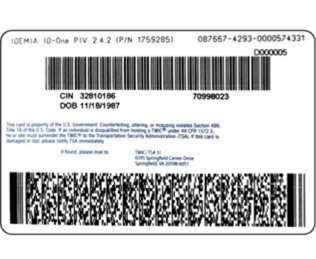
There are no changes to the front of the TWIC card, and the design remains the same as existing unexpired cards in circulation.
AWO Urges BOEM to Protect Navigation in Offshore Space Development. In comments submitted August 7, AWO urged the Bureau of Ocean Energy Management to ensure that any future offshore space launch or re-entry activities on the Outer Continental Shelf are sited and managed so as to protect navigation and preserve existing and proposed shipping safety fairways. AWO urged BOEM to work closely with the Coast Guard, vessel operators, and other maritime stakeholders to establish a clear process for evaluating the navigational footprint of launch-related hazard areas, incorporate navigation safety assessments into future siting decisions, and use existing mariner notification and operational control practices to reduce conflicts with commercial vessel traffic.
$35 Million in Small Shipyard Awards Announced. The Maritime Administration has announced the recipients of the 2026 Small Shipyard Grants. More than $35 million was awarded to 45 small shipyards, up from $8.75 million awarded last year. Several AWO members received awards, including James Marine, NABRICO, Gunderson Marine, Steiner Construction, Shaver Transportation, and The Cooper Group's Blakely Boat Works. Small Shipyard Grant funds are intended to modernize and increase productivity at U.S. shipyards and expand local employment opportunities. The full list of awardees can be found here.
AWO Comments on Hudson River Anchorage Rulemaking. AWO urged the U.S. Coast Guard to maintain a streamlined emergency anchoring notification process and ensure that captains retain the ability to make timely safety decisions without unnecessary administrative burden, in comments submitted to the Coast Guard Northeast District. AWO’s comment letter came in response to the Coast Guard’s recent rulemaking to implement the provisions of the 2026 NDAA prohibiting vessels from anchoring on portions of the Hudson River outside of designated federal anchorage grounds. The proposal preserves emergency anchoring authority but requires vessels to notify the Coast Guard when using that safety exception.
In addition to urging the Coast Guard to make notification as efficient as possible, AWO’s comments also emphasized that anchoring is a critical navigation safety tool used by mariners during periods of poor visibility, mechanical issues, and other unsafe conditions.
Corps Issues Stop-Work Order at Brandon Road. The U.S. Army Corps of Engineers (Corps) recently issued a stop-work order for construction at the Brandon Road Interbasin project (BRIP) in Joliet, Illinois.
Weekday lock closures were scheduled to begin in September 2026 and continue through April 2028. Despite the stop-work order, the navigation notice reportedly remains in place. Corps officials have not provided details regarding the scope of the review or how long the pause may last.
AWO has advocated against the BRIP’s inclusion of electric barriers, which threaten mariner safety, and has emphasized the importance of maintaining efficient navigation throughout the project’s duration.
For additional information, please contact Lillie Wightman.
Register for the 2026 AWO Fall Convention! Join AWO October 13–14 in West Palm Beach, Florida, for Navigating Disruption: Strength. Strategy. Resilience., where members will gain targeted insights, practical takeaways, and valuable networking opportunities to help navigate regulatory, economic, and operational challenges.
Members can book a room in the hotel block by September 12 or before rooms sell out, to take advantage of the discounted $279 rate.
Equipment Reporting for 2027 Now Open. AWO’s 2027 equipment reporting process is now open. Equipment reports should be submitted online through the AWO Member Portal or the AWO App by September 18. Please email Violet Daniels with any questions.
AWO PAC and Inside Elections. AWO PAC has partnered with Inside Elections for another special edition, featuring insights on key races where independent candidates have a chance of winning, primary results and updates in dozens of races around the country, and rating changes in four Senate races, four House races and three gubernatorial races.
AWO PAC is the connected political action committee for The American Waterways Operators and serves as the trade association's separate segregated fund. As a trade association, AWO is prohibited from using general treasury funds or membership dues to make federal contributions. AWO is one of the most effective advocacy associations in Washington, DC, and relies on voluntary personal contributions to fund AWO PAC.
AWO PAC supports federal candidates who are champions of the U.S. tugboat, towboat and barge industry and who are leaders on issues important to our industry. AWO PAC is dedicated to protecting AWO members' investments in the safest, most environmentally responsible and most economical mode of freight transportation and safeguarding the integrity of the Jones Act to protect the bottom lines of our members.
AWO PAC may solicit contributions from individuals of a member company once the member representative gives AWO written prior approval.